May 19, 2013
Place
image for

Our Place in the Ridge and Valley
 
“Every place is given its character by certain patterns of events that keep on happening there…The more living patterns there are in a place…the more it comes to life as an entirety, the more it glows, the more it has that self-maintaining fire which is the quality without a name.”

            Christopher Alexander, The Timeless Way of Building
 
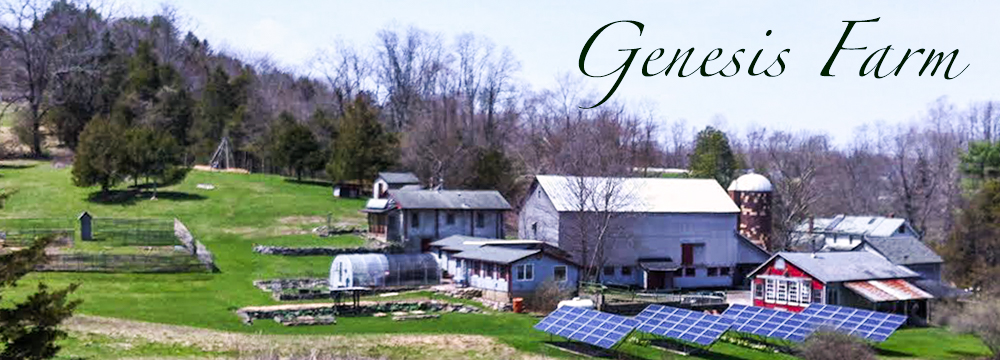
Genesis Farm is located in northwest New Jersey, in the geologic province of the Appalachian Ridge and Great Limestone Valley. This province stretches from Alabama up its frontal face along the eastern range of the North American continent. To be in this place is to be in a fragmentary moment of deep time. As in every place, deep time holds us in a pure grace of knowing our existence is a gift created by elements, events and relationships of past evolutionary time. It is to know that each of us has emerged out of the same evolutionary and geologic processes.
 
As described by The Ridge and Valley Conservancy, “The region is ancient. Layers of limestone, shale and sandstone found in seas more than 500 million years ago old were formed during the creation of the Appalachian Mountains. Millions of years of erosion have left gentle limestone valleys, rolling shale hills, and tough sandstone ridge. The natural wonders and cultural history of the Ridge and Valley Region are in part a product of its unique landscape.”
 
The Farm’s unique landscape is located about 10 miles from the Delaware Water Gap. This water gap was created millions of years ago when geologic pressure twisted and shattered its gray quartzite foundations. As the pressure forced the quartzite up, the Delaware River slowly cut its path through the ridge, carving Mt. Minsi from the Blue Ridge to the south and Mt. Tammany and the Kittatinny Ridge to the north. The Delaware Water Gap is a beloved legacy of these early and powerful forces.
 
The Wisconsin glacier covered the entire Ridge about 21,000 BC and melted about 13,000 BC leaving the Ridge running north through Pennsylvania, through this corner of New Jersey and up into New York and on to New England.  The Lenape, the early native peoples called the ridge Kittatinny, “endless hill. Its mountains and adjacent valleys are a mosaic of ecosystems – from unfragmented hardwood forests to valleys with unique bogs and fens, to the great freshwater complexes of the Delaware and Hudson rivers. The highest peak in the Ridge (which is also the highest in New Jersey) is at 1,803 feet.
 
Once covering the whole of the eastern U.S., the Kittatinny forests are now part of the largest remaining temperate deciduous forest on Earth. The Ridge is home to various oaks, hickories, and maples, as well as other hardwood species such as ash, elm, cherry, walnut, birch, sycamore and beech. It hosts populations of 33 mammal species that rely on this large expanse of remarkably intact forest, including black bear, bobcat, gray squirrel, white-tailed deer, red fox and gray fox, and coyote. 

The Kittatinny Ridge and Delaware River region is an important migratory corridor for bald eagles, peregrine falcons, bobcat, hummingbirds, osprey, wood ducks, kingfishers and all owls, hawks and swallows. Every autumn, thousands of raptors representing 16 different raptor species are reported atop the Ridge’s forested slopes. These hawk flights are some of the most internationally important raptor migrations in North America. Among the 143 bird species in the region are black-throated blue warbler, golden-winged warbler, Louisiana waterthrush, wood thrush, worm-eating warbler, grasshopper sparrow, and sedge wren.


Containing some of the most ecologically intact wetland complexes in New Jersey, the Kittatinny Ridge and Valley area is dotted with freshwater wetlands, glacial bogs, pristine streams, ponds and lakes. The unique geology of the region supports several globally threatened species, including the federally threatened bog turtle. Shad migrate up the river through the gap in the spring; others among the 55 fish species include bass, trout, carp and walleye. The area also hosts 49 species of amphibians and reptiles and 78 dragonfly/damselfly species. 

Paleo Indians inhabited the Delaware River Valley and Kittatinny Mountain around 10,500 BC, hunting, fishing and gathering plants to eat. Coniferous and deciduous forests mixed with grasslands in the valleys. The Marshall Creek Mastodon found just north of the Gap was dated at around 10,210 BC. Other big game at that time included caribou and musk ox.

About two thousand years ago, the Lenape peoples came to the area in search of food and game. The deciduous forest contained many varieties of nut trees, and the Lenape collected acorns, walnuts, hickory nuts, beech nuts, chestnuts, and butternuts. In the very late 1600's, the Dutch and other European settlers came to the region.. Foot travel was not possible through the Gap on either the New Jersey side or Pennsylvania side, as steep rock walls went into the Delaware River. A road was built on the Pennsylvania side of the river in 1793, and on the New Jersey side through the Gap going north in 1830.

With the coming of the Europeans, the immense fragmentation and ecological disturbance of the valley began…and it is in this moment of time that we dedicate ourselves to it future restoration.

The Ridge and Valley Conservancy has worked since 1992 to preserve forest, farmland, wetlands, and historic sites in this region. Through purchase and conservation easements, this organization works closely with other private and public conservation groups to permanently protect important watershed lands and wildlife habitat, particularly for rare and endangered plants and animals. They also work directly with landowners to help them choose the best ways to preserve their land. To date, nearly 3,000 acres of valuable forest, fields, and farmlands have been permanently set aside.